
Introduction: Why This Myth Persists
When people think of cybersecurity threats, they often imagine a hooded figure hunched over a keyboard in a dimly lit basement, launching sophisticated attacks from thousands of miles away. Headlines about ransomware gangs, nation-state hackers, and high-profile breaches reinforce the belief that the greatest danger comes from outside the organization. The reality is that insider threats, whether malicious or accidental, can cause equal or greater harm, especially in OT environments where mistakes can have immediate physical consequences.
In the IT world, that perception is somewhat accurate; many incidents stem from external attackers exploiting public-facing systems. However, in Operational Technology (OT), where systems manage manufacturing lines, power grids, water treatment facilities, and other industrial processes, this outsider-focused mindset can be dangerously misleading.
The reality is that insider threats, whether from deliberate sabotage, negligence, or simple mistakes, can be just as devastating. And in OT, where a single command can directly damage machinery, disrupt critical services, or endanger human life, the consequences of those insider risks are both immediate and severe.
The Myth in Context
It’s not hard to see why the “external hacker” narrative dominates. Outside attackers are easier to visualize and easier to blame. They make for dramatic headlines, urgent boardroom discussions, and a clear justification for investing in firewalls, intrusion detection systems, and antivirus tools.
OT security programs often inherit this IT-first thinking, focusing heavily on keeping bad actors out. While those defenses are essential, they address only part of the threat landscape. In many real-world OT incidents, the first harmful action doesn’t come from an intruder breaking through the perimeter; it comes from someone who’s already inside the network, inside the control room, or in the process workflow.
Sometimes that “insider” is a trusted employee cutting corners to meet a deadline. Other times, it’s a contractor making a configuration change without realizing the downstream impact. And in the worst cases, it’s a disgruntled individual intentionally causing damage. In every case, the starting point is the same: they already have access, and the systems already trust them.
Understanding Insider Threats in OT
When we discuss insider threats, an “insider” refers to anyone with authorized access to systems, processes, or facilities, whether the organization employs them, contracts for their services, or provides remote support. This access, combined with knowledge of how the systems operate, means that insiders can cause disruptions far more quickly than an external attacker, who must first breach the perimeter.
Insider threats in OT generally fall into three main categories:
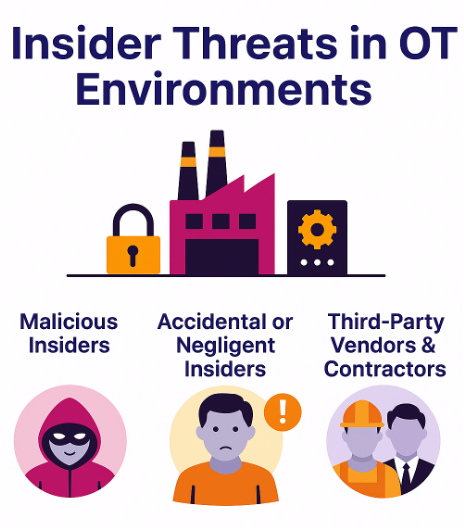
1. Malicious Insiders
These individuals act with intent to cause harm, often motivated by revenge, financial gain, or coercion. They may:
- Sabotage equipment or processes to disrupt operations.
- Steal proprietary process data for competitors.
- Tamper with safety systems to cause reputational or financial damage.
In OT environments, the risk is magnified because malicious insiders already know which systems are critical, where vulnerabilities exist, and how to exploit them without triggering obvious alarms.
2. Accidental or Negligent Insiders
By far the most common source of insider-related incidents is individuals whose mistakes, large or small, lead to unintended consequences. Examples include:
- Entering incorrect parameters into control systems.
- Disabling alarms or interlocks during troubleshooting and forgetting to restore them.
- Connecting unmanaged laptops, USB drives, or portable media to sensitive equipment.
Even without malicious intent, the result can be costly downtime, equipment damage, or safety hazards.
3. Third-Party Vendors and Contractors
Many industrial facilities depend on external specialists for installation, maintenance, and troubleshooting of complex systems. While essential, these relationships create additional risks:
- Contractors may use personal laptops or diagnostic tools with unknown security posture.
- Temporary accounts or credentials may remain active after the engagement ends.
- Remote access solutions for vendor support can become permanent, unmonitored backdoors, allowing unauthorized access.
In each of these categories, the common factor is trust in the systems designed to accept commands, configuration changes, or data from these individuals, without the same level of skepticism applied to unknown, external sources.
Why Insider Threats Hit Harder in OT
In IT environments, most security incidents impact data, whether through theft, corruption, or unauthorized disclosure. The effects are serious, but they’re often reversible with backups, forensic analysis, and recovery processes. In OT, the stakes are different: every system action ultimately ties back to a physical process.
When an insider makes a mistake or acts maliciously in an OT environment, the consequences can be immediate, costly, and dangerous. Several factors make insider risks uniquely damaging here:
1. Physical Consequences, Not Just Digital
A single incorrect command can cause a turbine to overheat, open a valve at the wrong time, or shut down a critical pump. The result could be damaged equipment, environmental spills, or even injury and loss of life.
- Example: In a chemical processing plant, a technician overrides a temperature control without realizing the reaction kinetics, triggering an uncontrolled release.
2. Bypassing Perimeter Security
Cybersecurity tools, such as firewalls and intrusion prevention systems, focus on preventing untrusted actors from gaining unauthorized access. Insiders have already bypassed that barrier. If the network has minimal internal segmentation, one user’s access can extend well beyond their immediate role.
- In many facilities, an engineer with physical access to a single PLC can quickly access multiple systems across the process network.
3. Operational Trust Model
OT operators are trained to trust their interfaces and respond quickly to alarms or system feedback. Suppose someone with legitimate access manipulates those commands or displays. In that case, the system will execute them without question, and the operator might not realize the danger until after the damage has occurred.
- Many systems have alarm management solutions, both locally and at a centralized onsite location, that assist operators in responding to process anomalies. If these alerts are not accurate, issues may be dismissed or ignored.
4. Legacy and Flat Architectures
Many OT networks still run on outdated systems that lack modern access controls, logging, or role separation. It is common to find flat legacy network architectures. Once inside, using shared accounts, lateral movement is often quick, easy, and goes unnoticed by Operations until it is too late, making the threat difficult to isolate.
In the past, automation and control networks were designed as stand-alone systems, with no external connections considered. But now, organizations want to become more efficient and establish connections between processes. This creates a pathway for lateral movement between networks if not properly designed.
5. Detection Gaps
Unlike IT systems, OT monitoring is often focused on process health rather than security. This means a malicious actor changing a pump schedule might not trigger a security alert, only a process alarm after damage has already begun.
Case Studies: Insider Threats in Action
Maroochy Shire Sewage Incident (2000)
A disgruntled ex-contractor used stolen SCADA equipment to issue unauthorized commands to sewage pumping stations in Queensland, Australia. Over several months, he released over 800,000 liters of raw sewage into waterways, killing marine life, creating foul odors, and endangering public health. His insider knowledge let him bypass safeguards and remain undetected for weeks.
German Steel Mill Incident (2014)
Initially reported as an “external cyberattack,” later analysis revealed that insider-level process manipulation also contributed to the damage to a blast furnace. Whether through cooperation or negligence, internal access played a role in preventing the furnace from shutting down safely, leading to extensive physical damage1,2.
Everyday Maintenance Errors
Not all insider threats are malicious. Here’s a story that may hit home;
A planned maintenance outage is necessary to implement a system update that will improve the system’s design. Like most organizations, engineers start their design and testing using an offline backup taken in the past, possibly even when the system was first commissioned. The engineer then makes all the required changes to the program, preparing it for deployment. He uploads the program, but nothing functions. After hours of troubleshooting, it is discovered that a maintenance technician encountered an issue a year earlier and made changes to the PLC program that bypassed several permissive conditions, allowing operators to continue working. Of course, he planned to return later to fix it, but operations never gave him the time. This outage, initially scheduled for one hour, has now lasted five hours, causing a business impact as it prevents delivery to clients. All of this was caused by an engineer not having the correct backup of the software running.
This story may be familiar to many of us responsible for maintaining and operating industrial processes, but it happens. Common examples include:
- Uploading the wrong PLC program from an old backup.
- Forgetting to re-enable alarms after calibration work.
- Connecting a personal laptop to the control network unknowingly introduces malware.
Across all cases, the pattern is the same: the actor had access, knowledge, and trust, and the damage went far beyond data loss.
Practical Steps to Reduce Insider Risk
- Role-Based Access Control (RBAC): Grant only the access necessary for each role; review regularly.
- Network Segmentation: Limit the reach of one account or workstation.
- Comprehensive Monitoring & Logging: Track PLC changes, operator commands, and configuration edits.
- Change Management Procedures: Require approvals and maintain rollback plans.
- Training & Awareness: Treat cybersecurity as part of your safety culture.
- Vendor Access Management: Use time-limited credentials and monitor third-party activity.
- Insider Threat Simulations: Practice detection and response to both malicious and accidental scenarios.
Balancing External and Internal Threats
External threats require strong perimeter defenses, secure remote access, and timely patching. Internal threats demand strict access control, continuous monitoring, and cultural change.
The strongest OT security programs plan for both scenarios, operating on the assumption that a threat could already be inside the fence line, and build layers of defense that keep operations safe even in that scenario.
Conclusion
The image of a distant hacker breaching your systems is compelling and worth defending against. But in OT, the more immediate danger may come from within: the engineer rushing to meet a production target, the contractor bypassing a safety interlock, or the disgruntled employee who knows exactly which command will cause the most damage.
External threats may dominate the headlines, but insider threats dominate the reality in many OT incidents. These threats bypass perimeter defenses, exploit the trust built into industrial control systems, and can turn a simple action into a costly, dangerous operational failure.
An effective OT security strategy does not choose between defending against outsiders and insiders; it does both. That means building layers of technical controls, enforcing strong operational discipline, and embedding cybersecurity into the same culture that already values safety and reliability.
In critical operations, the stakes are far higher than lost data. The systems we protect don’t just store information; they move water, generate electricity, manufacture products, and safeguard lives. And the people with the keys to those systems, whether they realize it or not, can be the most significant risk of all.
At Enaxy, we help organizations build comprehensive OT security programs that address both external and insider threats. From designing layered access controls and behavioral monitoring systems to training personnel on secure operational practices, we ensure your defenses protect not just data but people, processes, and the physical world itself.
Want to strengthen your OT defenses from the inside out? Contact us at info@enaxy.com to get started.
1 https://www.bbc.com/news/technology-30575104
2 https://cyberlaw.ccdcoe.org/wiki/Steel_mill_in_Germany_(2014)#cite_note-4