
In today’s industrial landscape reliability, efficiency, safety, and cybersecurity are no longer optional but fundamental requirements. As Operational Technology (OT) increasingly converges with Information Technology (IT), and as Industrial Control Systems (ICS) become more complex and distributed, organizations must gain deep, continuous insight into how their systems communicate. Without this visibility, blind spots in the network can lead to cybersecurity vulnerabilities, unplanned downtime, andregulatory non-compliance.
In our previous post, we introduced the two primary technologies shaping the industrial network monitoring landscape: SPAN (Switch Port Analyzer) and TAPs (Test Access Points). Each comes with its own strengths and trade-offs. Choosing the right tool requires a clear understanding of your network’s architecture, performance requirements, compliance obligations, and risk tolerance.
Advantages of Network TAPs in Industrial Networks
1. Enhanced Operational Insight
- Process Monitoring: TAPs offer granular, line-rate visibility into the communications between industrial devices PLCs, HMIs, sensors, and actuators. This enables operations teams to understand real-time system performance and data flows.
- Fault Detection: TAPs support full packet capture, helping engineers rapidly identify issues such as device misconfigurations, malformed packets, or dropped communications, ultimately reducing Mean Time to Resolution (MTTR) and unplanned downtime.
2. Cybersecurity Resilience
- Threat Detection: TAPs feed clean, full-duplex traffic to IDS/IPS and NSM tools, allowing deep packet inspection, signature matching, and behavior-based threat detection across both North-South and East-West traffic paths.
- Incident Response: In the event of a cyber incident, TAPs provide complete, forensic-quality traffic records enabling thorough root cause analysis, incident containment, and future mitigation planning.
3. Regulatory Compliance
- TAPs are especially valuable in industries subject to regulatory mandates (e.g., NERC-CIP, IEC 62443, TSA pipeline security directives). They enable detailed activity logging and audit trail generation to meet compliance standards.
4. Brownfield Compatibility
- Legacy-Friendly: Many legacy switches in brownfield sites do not support SPAN or have limited capabilities. TAPs operate independently of the switch, making them ideal for retrofitting modern monitoring into older infrastructure.
- Cost-Effective Modernization: TAPs allow visibility upgrades without requiring costly switch replacements, significantly reducing downtime and integration effort.
Disadvantages of Network TAPs
1. Integration Challenges
- Legacy Systems: TAP deployment may require additional components such as media converters, protocol decoders, or passive optical splitters to ensure compatibility with proprietary or non-standard protocols.
- Segmented Networks: In OT environments with security zones or VLAN segmentation, careful TAP placement is required to maintain compliance with isolation policies.
2. Performance Considerations
- Bandwidth Load: Monitoring tools must be capable of processing full-duplex traffic without dropping packets. This can place demands on storage, CPU, and memory resources.
- QoS Awareness: TAPs operate at the physical layer, so monitoring solutions must understand and respect Quality of Service (QoS) policies used in time-sensitive control traffic.
3. Operational Resilience
- Potential Single Points of Failure: Inline TAPs must be configured with fail-open or bypass features to prevent disrupting communication in the event of power loss.
- Support Infrastructure: TAPs require additional rack space, power, and integration with packet brokers or aggregators, resources that must be planned and maintained.
Advantages of SPAN in Industrial Networks
1. Broad Network Visibility
SPAN mirrors traffic from one or more switch ports or VLANs, allowing visibility into control traffic, enterprise services, and data flows all without adding inline hardware.
- Enables centralized traffic capture.
- Ideal for environments where visibility is needed across many ports simultaneously.
- Quick to deploy in greenfield environments with modern managed switches.
2. Security Monitoring
- When integrated with SIEM, IDS, or NSM platforms, SPAN provides insight into unauthorized access attempts, policy violations, and network anomalies.
- Offers real-time visibility into both routine operations and potential threat activity.
3. Performance Analytics
- SPAN enables the tracking of key performance indicators such as latency, jitter, packet loss, and bandwidth usage.
- Helps optimize network traffic routing and prioritize critical workloads.
4. Compliance Support
- Assists with generating logs and audit trails required for regulatory compliance and incident response.
- Supports centralized forensic investigations and reporting.
Disadvantages of SPAN in Industrial Networks
1. Switch Dependency and Complexity
- Requires Managed Switches: Unmanaged or limited-function switches do not support SPAN.
- Hardware Limitations: Many switches support only a few simultaneous SPAN sessions, and mirroring high-speed links can saturate switch CPUs.
- Configuration Challenges: SPAN setup varies by vendor and can introduce complexity in large-scale environments.
2. Potential Packet Loss
- Under high utilization, SPAN ports can drop packets (especially in mirrored high-throughput sessions) making it unsuitable for applications that require forensic accuracy.
3. Data Sensitivity
- SPAN captures all mirrored traffic, including sensitive or confidential information. This requires strict access controls, secure storage, and encryption to ensure compliance with data protection policies.
4. Retrofitting Brownfield Networks
- Adding SPAN to existing industrial networks may require firmware upgrades, switch replacements, or changes to traffic patterns all of which can be disruptive and costly.
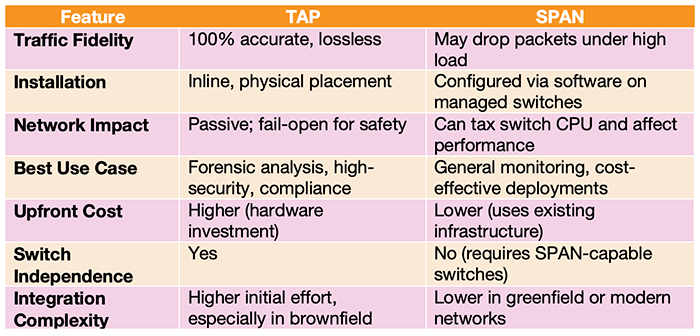
TAP vs. SPAN at a Glance
Finding the Right Fit
SPAN and TAP technologies each play vital roles in building a secure and resilient industrial network monitoring strategy. The right choice depends on your organization’s risk profile, operational goals, compliance requirements, and infrastructure maturity.
- SPAN is best suited for environments that require quick deployment, broad visibility, and minimal hardware investment.
- TAPs are ideal for high-security, high-integrity applications where zero packet loss, forensic-level monitoring, and regulatory audit support are essential.
In many cases, a hybrid model using SPAN for general coverage and TAPs for high-risk or compliance-sensitive segments strikes the right balance between cost, visibility, and operational integrity.
Need Help Designing the Right Monitoring Architecture?
At Enaxy, we’ve helped clients across manufacturing, oil & gas, energy, and utilities implement scalable, secure, and compliant network visibility strategies. Whether you’re starting fresh or enhancing an existing infrastructure, we’ll help you deploy the right mix of SPAN and TAP technologies to meet your goals.
Contact us at info@enaxy.com to schedule a consultation or technical assessment.
Stay tuned for more in our industrial monitoring series, where we’ll explore deployment best practices, integration tips, and real-world case studies from Enaxy field teams.