
In Operational Technology (OT) and Industrial Control System (ICS) cybersecurity, two foundational security models are guiding how organizations protect critical infrastructure: the Confidentiality, Integrity, and Availability (CIA) triad, and the more recent Safety, Reliability, and Performance (SRP) triad.
While the CIA triad is traditionally rooted in information security, which focuses on protecting digital assets like data and systems, the SRP triad reflects the unique operational demands of industrial environments. Safety, reliability, and performance are paramount when safeguarding physical processes and human lives.
These models may appear distinct, but they are complementary. Together, they offer a holistic lens through which cybersecurity strategies can be aligned with both IT and OT priorities.
CIA Triad
The CIA triad has long stood as a fundamental framework for cybersecurity, particularly within the realm of Information Technology (IT). Its primary aim is to ensure that digital assets are protected, accurate, and accessible only to those with proper authorization. Here’s how each component contributes to a secure IT (and increasingly OT) environment:
- Confidentiality: Keeps sensitive information out of unauthorized hands. This is crucial for protecting proprietary data and other confidential materials.
- Integrity: Ensures data is accurate and unaltered. It’s about maintaining the trustworthiness of information, whether it’s stored or in transit.
- Availability: Makes sure that systems and data are accessible when needed. In IT, availability is linked to uptime and the ability to access information without disruption.
While originally developed for traditional IT, the CIA triad also plays an essential role in OT/ICS. For example, ensuring the availability and integrity of real-time sensor data is as critical to a manufacturing plant as email availability is to a corporate office. However, the priorities and risks in OT environments differ, which necessitated the emergence of the SRP triad.
SRP Triad
While the CIA triad governs the protection of digital data, the Safety, Reliability, and Performance (SRP) triad, developed by OT expert Jake Brodsky, addresses the unique and often life-critical priorities of OT/ICS.
Here’s how the SRP triad breaks down:
- Safety: A fundamental pillar of OT, safety cannot be overstated. In this domain, safety regulations are often described as “written in blood,” as a reminder of past operational failures. A robust cybersecurity posture ensures that no system vulnerability can compromise worker safety, environmental integrity, or industrial equipment.
- Reliability: Industrial systems must function consistently over time. A brief outage or glitch may be inconvenient in IT, but in OT it can lead to plant shutdowns, equipment damage, or cascading supply chain delays.
- Performance: In production-centric environments, performance is directly tied to output quality and efficiency. Ensuring that processes run within tightly controlled parameters is key to profitability and any cyber disruption must not degrade throughput, cycle times, or process stability.
The SRP triad addresses the specific needs of OT/ICS environments. OT/ICS environments are not just about data, they’re about keeping physical systems running predictably and safely, often in sectors like energy, transportation, manufacturing, and critical infrastructure.
Where CIA Meets SRP: Bridging Security Principles Across IT and OT
While the CIA and SRP triads were developed for distinct environments, IT and OT respectively, they are not mutually exclusive. In fact, there are critical points of alignment between the two that offer a foundation for unified cybersecurity strategies across converged IT/OT networks.
- Integrity (CIA) ↔ Reliability (SRP)
Both focus on ensuring that systems function correctly and that data or operations remain consistent, unaltered, and trustworthy. In IT, this prevents data corruption or malicious tampering. In OT, it ensures process continuity and operational predictability which is especially vital in environments where uptime is mission-critical. - Availability (CIA) ↔ Performance (SRP)
These elements share a focus on accessibility and efficiency. In the digital world, this means ensuring users can access systems when needed. In the industrial world, it means maintaining throughput, minimizing downtime, and ensuring equipment runs within specified parameters.
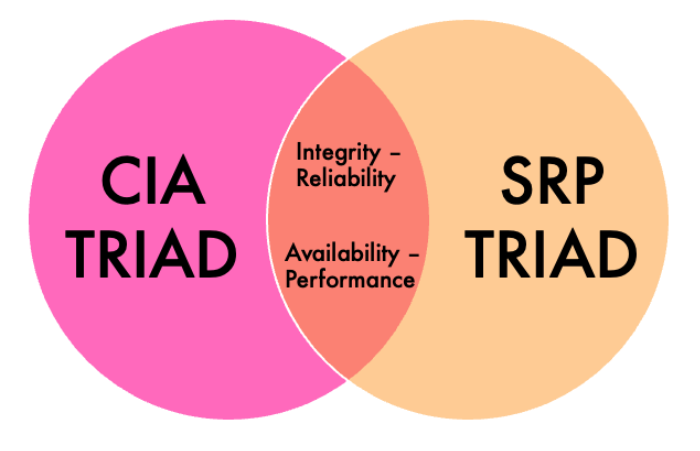
The key difference is their focus:
- The CIA triad prioritizes the security of digital assets, emphasizing data protection and system accessibility.
- The SRP triad prioritizes the safety and reliability of physical operations, focusing on preventing incidents that could lead to physical harm or operational disruptions.
In OT/ICS settings, where digital and physical systems are deeply intertwined, relying solely on one triad risks leaving critical aspects of the environment unprotected. Striking the right balance is essential.
Given their distinct yet complementary focuses, leveraging both the CIA and SRP triads provides a holistic approach to securing OT/ICS environments. Each triad brings unique value, one rooted in digital security and the other in operational safety and resilience.
Engineers and operations professionals are trained early to prioritize safety, reliability, and performance. These principles form the backbone of process engineering and industrial operations. Their focus is on keeping systems running smoothly, minimizing risk, and avoiding any operational disruptions that could endanger personnel, equipment, or the environment.
The SRP triad directly supports this mindset. It provides a language and framework that aligns with how these teams already approach their work, making it an effective model for embedding cybersecurity within the fabric of industrial operations.
While engineers focus on physical systems, cybersecurity professionals uphold the CIA triad to protect the digital infrastructure that underpins OT operations. The two teams work in tandem:
- Confidentiality safeguards access to control systems and sensitive data.
- Integrity ensures accurate sensor readings, configurations, and commands.
- Availability guarantees that control systems and HMI platforms remain online when needed.
By maintaining data integrity and system availability, cybersecurity plays a pivotal role in enabling reliable and high-performing operations. In this way, the CIA triad doesn’t compete with SRP but supports and enhances it.
Enaxy’s Approach to Integrated Security
At Enaxy, we understand that protecting industrial environments isn’t just about deploying firewalls or patching software. It’s about enabling engineers and operators to meet SRP objectives without compromising security. We help bridge the gap between OT and IT by:
- Translating cybersecurity goals into operational outcomes
- Embedding CIA principles into OT risk frameworks
- Building teams that collaborate across engineering, operations, and security
Our mission is to ensure that both digital and physical assets are protected, and that organizations can operate safely, reliably, and securely in an increasingly interconnected industrial world.
To learn how Enaxy can help you align cybersecurity with operational excellence, contact us at info@enaxy.com.