
When many industrial operators hear about cyberattacks, their minds jump to high-tech targets, modern cloud platforms, corporate IT networks, and state-of-the-art control systems. The assumption often follows:
“Our legacy OT systems are too old for hackers to care about. These systems are obscure, proprietary, and isolated. We’re safe.”
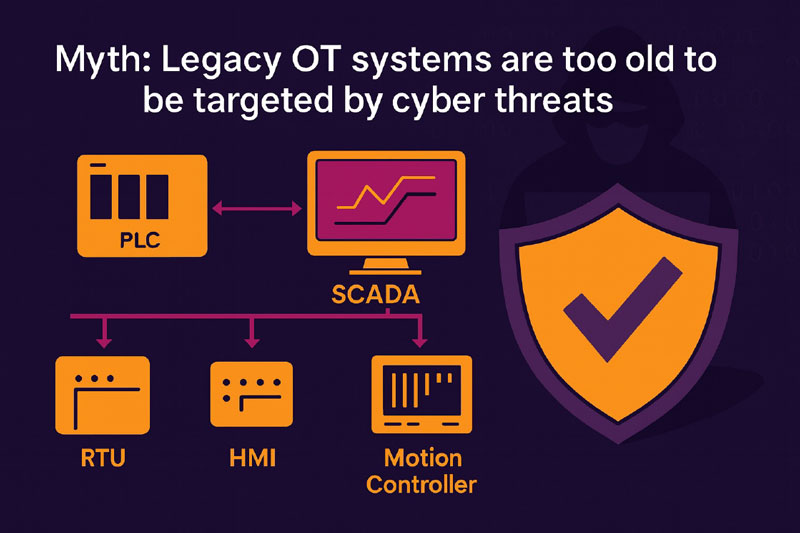
This belief is not only outdated, but also dangerous. Legacy OT (Operational Technology) systems are prime targets for cyber adversaries precisely because they are old, under-patched, and often lack basic security features. In some cases, their vulnerabilities are public knowledge, making them easier to exploit than modern systems.This article will debunk the myth by examining real-world incidents, the changing threat landscape, and fundamental cybersecurity principles that demonstrate why legacy OT is not “too old” for attackers; it’s an open invitation.
Why This Myth Persists
Before diving into the facts, it’s worth understanding why so many OT professionals believe this myth:
- Obscurity as Security – The idea that “no one knows how this old PLC works” or “attackers won’t bother learning” is still common in the OT space.
- Air-Gapping Assumption – Many legacy systems were initially deployed in isolated environments, but network changes, remote access, and IT/OT convergence have eroded that isolation.
- Budget Priorities – Legacy OT systems cannot be upgraded due to the high cost of replacing or implementing security measures, resulting in minimal investment in cybersecurity protections.
- Misplaced Focus – Cybersecurity conversations in industry often focus on the “latest” threats, making legacy assets seem less urgent.
The reality is that attackers are highly motivated to learn how to exploit older systems, especially when those systems control critical processes.
Cybersecurity Principle #1: Security Through Obscurity Is a Fallacy
Security through obscurity assumes that because a system is niche, hard to find, or complex, it is inherently secure. In modern cybersecurity, this is a proven anti-pattern.
Why?
- Attackers have time, tools, and motivation.
- Publicly available information on legacy OT protocols and architectures is abundant in academic papers, vendor manuals, and leaked technical documents.
- Reverse engineering is easier today thanks to advanced forensic tools.
Example:
The Havex RAT campaign (2013–2014) targeted industrial control systems by scanning for and exploiting OPC (OLE for Process Control) servers. Many of the targeted systems were decades old, but the attackers successfully mapped industrial networks and exfiltrated data.
Takeaway: If your defense relies on attackers not knowing how your old system works, you are already exposed.
Cybersecurity Principle #2: Vulnerabilities Never Expire
One of the most dangerous misconceptions about legacy OT systems is that their age makes them irrelevant to attackers. Old vulnerabilities remain forever exploitable unless they are patched or mitigated.
- Legacy PLCs, RTUs, and HMIs often run firmware that has not been updated in decades.
- Many use insecure-by-design protocols such as Modbus, DNP3, or early versions of proprietary protocols without encryption or authentication.
- Public exploit kits and Metasploit modules exist for these protocols.
Case in Point:
The Triton/Trisis malware attack (2017) targeted a Triconex safety instrumented system, technology first introduced in the 1980s. Despite its age, attackers were able to modify logic in the safety controller, potentially enabling dangerous conditions in the physical process.
Security lesson: Vulnerabilities in legacy OT don’t “age out” of the threat landscape. They remain open doors.
Cybersecurity Principle #3: Attack Surface Increases with Connectivity
Legacy OT systems were often designed for air-gapped environments, but operational realities have changed:
- Remote vendor maintenance connections
- Integration with corporate IT systems for monitoring and reporting
- Wireless networks and devices are introduced into legacy environments
These changes mean that even an old PLC or HMI, once completely isolated, can now be reached from the internet, directly or indirectly.
Real-World Example:
The Oldsmar, Florida, water treatment plant attack in 2021 involved a remote access system connected to plant operations. While the attacker’s method was crude, the critical point is that an older, poorly secured system became exposed through remote connectivity, allowing malicious changes to chemical dosing levels.
Cybersecurity Principle #4: Legacy Systems Are Less Resilient
Even if attackers cannot fully compromise a system, legacy OT often lacks the resilience to recover quickly from disruptions:
- No built-in intrusion detection or logging features
- Hard-to-source replacement parts
- Proprietary vendor dependencies that slow down incident response
This means even a low-skill attack, such as a denial-of-service flood against a Modbus TCP endpoint, can result in prolonged downtime and costly outages.
Example:
The Maroochy Shire sewage incident (2000) in Australia was an early example where a disgruntled insider manipulated wireless SCADA controls, releasing sewage into local waterways. The attacker didn’t need advanced malware, just access to poorly protected, older systems.
Cybersecurity Principle #5: Threat Actors Know Legacy Systems Are Critical
From a strategic perspective, attackers, especially nation-state actors and ransomware groups, understand that older OT systems often run mission-critical processes that cannot easily be shut down or replaced.
- Disrupting them creates maximum operational and economic pressure
- In many cases, victims have no choice but to pay ransoms or accept production losses
Case Study:
The Colonial Pipeline attack (2021) primarily affected IT systems, but the operational shutdown was due to the pipeline operator’s inability to ensure OT safety. Many of these OT components were legacy assets with limited visibility, making restoration slow and costly.
Why Attackers Love Legacy OT Systems
Let’s summarize why legacy OT is so appealing to attackers:
- Known, Unpatched Vulnerabilities – Some CVEs for industrial devices are decades old.
- Weak Authentication (or None at All) – Many legacy protocols assume a trusted network.
- Minimal Monitoring – Lack of logging and intrusion detection makes detection difficult.
- High Operational Impact – Disrupting legacy OT can halt entire operations.
- Slow Recovery – Replacement parts and system restoration can take days or weeks.
In other words: low risk, high reward for the attacker.
Modern Threats to Legacy OT Systems
Even if your system is old, attackers are using new tactics to target it.
- Ransomware with OT-aware capabilities – Groups like LockBit and BlackCat increasingly target ICS environments.
- Supply Chain Exploits – Compromised vendor software updates or maintenance laptops can deliver malware into old OT networks.
- Living-Off-the-Land (LotL) Techniques – Using built-in tools and features of legacy systems against themselves (e.g., modifying ladder logic directly).
- Automated Scanning – Tools like Shodan make it easy for attackers to find exposed ICS devices worldwide, regardless of age.
Defending Legacy OT: Practical Cybersecurity Measures
If replacing your legacy OT systems is not immediately feasible, there are still effective ways to reduce risk.
1. Network Segmentation
- Place OT networks in separate, secured VLANs or physical segments.
- Use firewalls and data diodes to control traffic between IT and OT strictly.
2. Strict Remote Access Controls
- Disable vendor remote access unless necessary.
- Require VPNs with multi-factor authentication for all remote sessions.
3. Monitoring and Detection
- Deploy OT-aware intrusion detection systems (IDS) such as Dragos, Nozomi, or Claroty.
- Monitor for unusual traffic patterns or unauthorized logic changes.
4. Compensating Controls for Insecure Protocols
- Wrap insecure OT protocols in secure tunnels.
- Use protocol whitelisting where possible.
5. Vulnerability Management
- Maintain an inventory of all OT assets, including firmware versions.
- Apply available patches or mitigate vulnerabilities with configuration changes.
6. Incident Response Planning
- Develop OT-specific incident response runbooks.
- Pre-stage spare parts and backup configurations for quick recovery.
Busting the Myth with Facts
- Myth: Old OT systems are obscure and therefore safe.
Fact: Attackers share knowledge, reverse-engineer protocols, and have the tools to exploit legacy systems. - Myth: Air-gapping protects old OT from attacks.
Fact: Modern OT is rarely truly isolated; remote access, IT/OT integration, and IoT expansion increase exposure. - Myth: Legacy OT isn’t worth targeting.
Fact: It’s often the most critical and least protected part of operations, making it extremely attractive to attackers.
Final Word
Legacy OT systems are not immune to cyber threats; they are often more vulnerable than modern systems. Believing they are “too old to be targeted” is a dangerous myth that can lead to complacency, inadequate defenses, and, ultimately, operational disruption.
Cybersecurity in OT environments isn’t about chasing the latest technology; it’s about protecting the assets you already have, especially the old ones that still run the core of your operations. Attackers know where the weak points are. Your job is to ensure they aren’t the easiest way in.
Remember: Age doesn’t make OT systems invisible; it makes them more predictable.
At Enaxy, we specialize in securing legacy OT environments. We help organizations harden outdated systems, implement compensating controls, and build layered defenses that protect critical operations without disrupting production.
Concerned about your aging OT infrastructure? Let’s strengthen it together. Contact us at info@enaxy.com to get started.